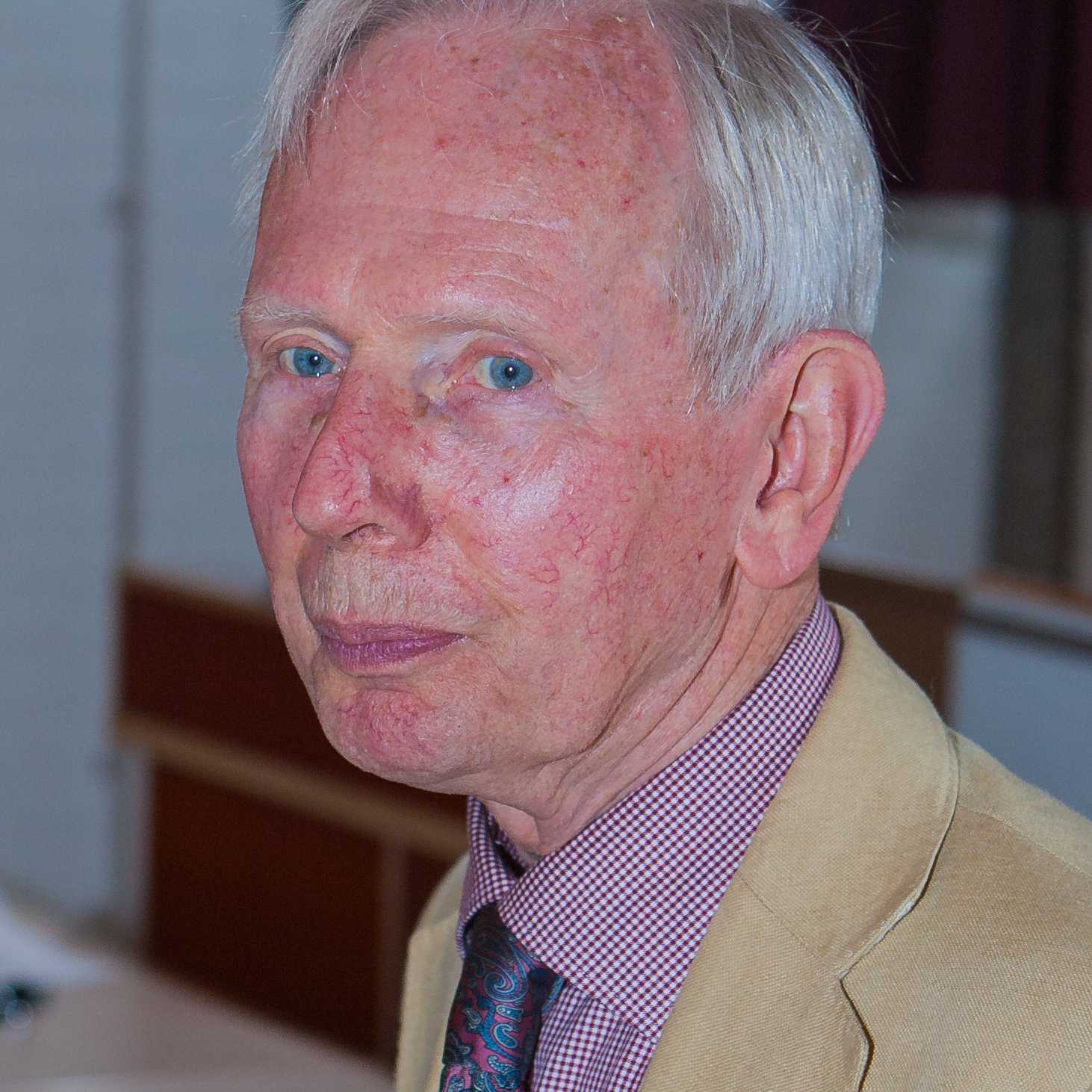
Jan G. Platvoet
Publications
Filter by type:
Bespreking van Geo Widengren 1969, Religionsphänomenologie (Berlijn: W. de Gruyter, 684 blz., DM 38), in Tijdschrift voor Theologie 11, 1: 79
Review of Geo Widengren 1969, Religionsphänomenologie (Berlijn: W. de Gruyter, 684 blz., DM 38), in Tijdschrift voor Theologie 11, 1: 79
Summary
In view of the rapid changes in all societies at present, this article starts from the assumption that the study of religions should move away from a static and system-centered approach to a dynamic one that focuses on the changes and shifts which take place in religions, on the interactions and interdependencies which in a specific place-time context develop between the religions that co-exist in that context, and on the functions, oppositional, complementary or other, which they fulfill in the religious life of the individual believer in that total context. Along these lines a study of the shifts is attempted that have occurred in Asante religion since the beginning of the colonial era. They are exemplified especially in the upsurge of the belief in, and the fear of, witchcraft and sorcery, the rise of the new cults of the ‛drinking medicine gods’ and the ‛executioner gods’ who [are believed to] fight mystical aggression, and the apparent shriveling of the place of the sky god Nyame, the ‘supreme god’ of this religion.
Samenvatting
De redactie van Areopagus vraagt mij enkele gedachten te formuleren rond twee vragen: (1) Wat is ‘theologie’? Heeft theologie een integratiepunt, een (kloppend) hart, en zo ja, waar en hoe is dat vinden? (2) Hoe verhouden de vakken of disciplines van een theologieopleiding [zich] tot die ‘theologie’? Vooral, hoe verhouden de empirische godsdienstwetenschappen zich tot de ‘theologie’? Kunnen ze in de ‘theologie’ geïntegreerd worden, of staan ze ermee op gespannen voet? Of, vanuit de student bezien: kunnen de empirische godsdienstwetenschappen een verdieping, verrijking en harmonische uitbouw van de theologische studie zijn, of zijn ze een corpus alienum, dat je moet afstoten, wil je een disintegratie van je theologie en van je persoonlijk geloof voorkomen?
Summary
The editors of Areopagus request that I formulate some thoughts around two questions:
= What is ‘theology’? Does theology have an integration point, a (beating) heart, and if so, where and how may that be found?
= How do the subjects or disciplines of a theology program relate to that ‘theology’? And more to the point how do the empirical sciences of religion(s) relate to ‘theology’? Can they be integrated into ‘theology’, or are they at odds with it? Or, from the student’s point of view: can the empirical sciences of religions deepen and enrich theology and develop in harmony with it, or are they a corpus alienum, that must be rejected, if you want to forestall that your theology disintegrates as well as your personal faith?
Response to Prof. Jonker’s “Gedachten over Zuid-Afrika”, in Areopagus 9, 5 (Oct. 1976): 14-17
to be posted
to be posted in due time
to be posted
to be posted
to be posted
Deze bijdrage aan het handbook Inleiding tot de studie van godsdiensten onder redactie van D.J. Hoens, J.H. Kamstra, & D.C. Mulder (Kampen, Kok, 1e druk 1984, 3e druk 1998): 45-60, voetnoten 225-226, heft als titel: “Drie stromingen in de godsdienstwetenschap: een korte geschiedenis van dit vak”. Ik bespreek, in historische volgorde, de “reductionistische” stroming, ontstaan in de Verlichting, de “religionistische” stroming, die voortkwam uit de vrijzinnige theologie van de 19e eeuw, en de “empirische” stroming”, ontstaan na 1950 in de postkoloniale tijd door interactie met de studie van godsdiensten in de antropologie.
to be posted
In deze bijdrage aan een handbook beschrijf ik het bezoek dat de gouvernmentsantropoloog Rattray op vrijdag 5 maart 1922 bracht aan het dorpje Tanoboase, ‘hoofdkwartier” van Tano, de belangrijkste god in het pantheon van de Akan na de hemelgod Nyame. Rattray wilde graag van ‘Tano zelf’, via het medium van Tano, toestemming krijgen dat zijn priesters voor hem een ‘echt’ tabernakel/schrijn van een ‘zoon van Tano’ zouden maken, en dat hij die ‘verblijfplaats van die god’ dan mee zou mogen nemen naar Engeland om hem in 1924 in London op een grote koloniale expositie ten toon te stellen.
to be posted
It is the purpose of this paper to explore one symbol complex by which the Akan themselves expressed how they viewed their societies and political order. They objectified and sacralised these views in a politico-religious (‘civil religion’) institution that was a prominent feature of Akan towns in pre-colonial times: the gyedua, ‘tree of reception’. It was an instrument they used primarily for expressing, maintaining, or restoring, the ‘proper’ political order. This paper will deal especially with the functions of the gyedua in Akan external and internal political relationships, and produce by doing so ‘emic’, i.e. native or insider, images of Akan identity.
to be posted
to be posted
to be posted
Dit artikel heeft vier delen. Ik spreek eerst over het belang van godsdiensten zonder schrift voor de godsdienstwetenschap. Daarna over de wijze waarop ik in dit artikel deze godsdiensten benader. Dan volgt eerst een beschrijving van de kenmerken die samenlevingen zonder schrift, als context van deze godsdiensten, gemeen hebben; en daarna van die van die godsdiensten zelf. Ik besluit met een toepassing van enkele van de inzichten die ik in deze bijdrage ontwikkel op een studie van Bouritius.
to be posted
to be posted
This article was published in Method & Theory in the Study of Religion 2, 2
(November 1990): 180-212. It is the first revised version of the paper I presented at the XVIth
IAHR Quinquennial Congress of the International Association for the History of Religions at
Rome, 3-8 September 1990. In 1994, it was also published in a slightly revised version as: Jan
G. Platvoet 1994, ‘Defining the Definers: Non-verifiability/Non-falsifiability as a definiens in an
operational definition of religion’, in Ugo Biachi (ed.) 1994, The Notion of ‘Religion’ in
Comparative Research: Selected Proceedings of the XVIth IAHR Congress. Roma: L’Erma di
Brettschneider, 701-711. The version below has also been amended. The page numbers of the
MTSR article are indicated in bold between square brackets.
To be posted
Samenvatting: Op het verzoek me kort aan de Leidse faculteitsgemeenschap voor te stellen vertel ik waarom ik in Leiden ben aangesteld, en waarvoor, wat ik in Utrecht deed, en hoe mijn leven is verlopen.
Summary: Having been requested to introduce myself to the students and staff of the Leiden faculty of Theology I briefly tell why I was appointed at Leiden and for what tasks; what my assignments at Utrecht were; and add a bit of auto-biographical information.
to be posted
This chapter has two parts. In its first part, a new classification of the history of religions is presented and the position of African traditional religions in them is discussed. It is shown that all religions developed traits after the type of society in which they were practiced. The origin of African traditional religions is in small oral societies. In the second part, these communities are described and the traits African traditional religions have in common. The purpose of this contribution is to show that African traditional religions need not be seen as superstitious magic nor as works of the devil. They can be seen as, and are in fact, respectable religions.
This article, ‘Kuenen’s Sheet Anchor: An Investigation of his Hibbert Lectures’, was my contribution to a special issue of Té-èf: Blad van de Theologische Faculteit te Leiden, 21, 3 (maart 1992): 43-56, commemorating the centenary of the death of the world famous Leiden Biblical scholar Abraham Kuenen (1828-1891).
I have added the page numbers in bold between square brackets. I have made a few small changes in the text.
to be posted
The Revenge of the ‘Primitives’: History of Religions from Neanderthals to New Age
A new framework for the general history of religions is offered in this article. I discuss first the reasons why this new framework has been developed. They are the need to replace the present defective division in primitive, ancient and world religions by a more adequate one; the need to approach historical religions as an object of comparative religion; and the need to enhance the explanatory power of the study of religions. The framework proposed hinges on the history of religions being part of the history of human societies, and therefore dependent on their histories. Six types of human societies are then sketched and the six corresponding kinds of religions. The study concludes with ‘the revenge of the “primitives”’: the marks of the historically earliest types of religions re-emerge in the newest religions of humankind.
to be posted
Jan G. Platvoet 1993, ‘Programmatic Statements from Africa: A Review Article’, in Numen 40, 3: 322-342
In this article, I review J.S. Krüger 1982/1988, Studying Religion: A Methodological Introduction to Science of Religion. Pretoria: University of South Africa; M.H. Prozesky 1984, Religion and Ultimate Well-being: An Explanatory Theory. London: Macmillan; and J.K. Olupona 1991, Kingship, Religion, and Rituals in a Nigerian Community: A Phenomenological Study of Ondo Yoruba Festivals. Stockholm: Almqvist & Wiksell International
Note that I have added a Postscript summarizing Martin Prozesky’s response to my review of his Religion and Ultimate Well-being.
to be posted
This review was published in Numen 40, 3 (1993): 349-350. I have made a few minor editorial changes in the text.
Review of Richard Gray 1990, Black Christians and White Missionaries (New Haven/London: Yale University Press), in Numen 40 (1993): 350352
A new framework for the general history of religions is offered in this study. I discuss first the reasons why I have developed it. They are [1] the need to replace the current defective division of humankind’s religions in primitive, ancient and world religions by a more adequate one; [2] the need to treat them as objects of the comparative study of religion(s); and [3] the need to enhance the explanatory power of comparative religion. The framework I propose conceives the general history of religions as part and parcel of the general history of the societies of humankind. It consists of six types of human societies and six corresponding kinds of religions. The study concludes with ‘the revenge of the “primitives”’ by demonstrating that the marks of the earliest religions have re-emerged in the most recent ones.
This article presents a survey, and an appreciation, of the academic study of religions in South and Southern Africa. As I cannot boast of the knowledge of an insider, I borrow a simile from an Akan proverb, that of Hawk sailing on high, to express not only my relationship to this part of our discipline, but also my weak credentials for undertaking this job, and my limited goals.
to be posted
This article was published in Nederlands Theologisch Tijdschrift 48, 1 (January 1994): 22-38.
Summary
Jan G. Platvoet 1994/2017, Confessing and Contesting ‛Religionism’: Recent Developments in Anglo¬phone Science of Religions
‛Religionism’ is defined in this article as a position in the academic study of religions that claims that the special nature of religion forbids that religions are subjected to the ‛reductionist’ explanatory theory of the type pursued in the past in respect of religion in the social sciences. Religionism is one of four attitudes that have been taken in respect of how religions should be studies in the past. They are: theological reductionism, positivist reductionism, religionism, and agnosticism. After having briefly described the first two and the last one and their historical connections, I detail the seven marks of religionism. I discuss its hegemony in the Anglosaxon academy. In most English speaking parts, it is uncontested. I discuss three recent publications from Africa as examples of this situation. The supremacy of religionism in the study of religions has, however, increasingly been contested on the North American continent in the last two decades. I survey the most recent phase of that polemic by discussing the argument in favour of religionism as developed by Daniel Pals and the responses to it of Segal and Wiebe. I conclude by pointing out that religionist approaches are found also among social scientists, as are non-religionist ones among scholars of religions.
Jan G. Platvoet 1995, ‘God als vijand: De genezingsdansen van !Kung’, in Nederlands Theologisch Tijdschrift 49, 2: 89-107
Summary
God as Enemy: !Kung Curing Dances
In the 1950s and 1960, only a few !Kung San, or Bushmen, continued to follow the traditional way of life of nomadic foodgathering in the Kalahari semi-desert of Southern Africa. Their religion is discussed in this article. Its central ritual was the curing dance. It is an all-night ritual, which they often practiced. It served as their major means for maintaining solidarity in their nomadic bands and for removing conflict from it – another means being the sharing of the food they gathered and meat they hunted. They maintained solidarity through the curing dance, for one reason because the dance was itself a process of sharing, of n/um, ‛curing power’; and for another because it was a ritual of exclusion. God and the deceased were blamed for all the evil present in the group, declared personae non gratae and refused admission as unwelcome aliens, the !Kung waging a continual ritual war upon them as their sole enemies. The special interest of this religion and this ritual for the comparative study of religions is highlighted by an examination of the link between the anthropological study of the !Kung curing dances and recent archaeological research on the San rock paintings, of which thousands have been found all over Southern Africa. They are interpreted now as reflecting a tradition of San curing dances which dates back many millennia.
The studies collected in this volume were presented as papers at an international conference in Leiden University on 14 and 15 January 1994 in order to study the role of religions in situations of religious pluralism, i.e. in what manner did religions respond to the presence of other religions in their societies, in ancient as well as in modern times. The volume has three parts. Part one consists of five articles of a mainly theoretical nature: Platvoet’s on ritual theory; Snoek’s on the conditions under which a group may feel a strong or weak, or feel no need at all to demarcate itself from other groups; Belier’s on the absence of that urge among Australian Aborigines; Drooger’s on a model for the study of the interaction among religions in a plural society; and ter Haar’s, on African Christian communities in The Netherlands which do not wish to demarcate themselves from Western Christian communities. Part two has three papers by Nugteren, Sadan, and Platvoet that deal with the ritualisation of the encounter between religions, peaceful, repressive, or aggressive. Part three has five papers by van der Toorn, Beck, Kaptein, van Koningsveld, and Wiegers that describe responses of religions to situations of religious plurality. They deal with processes of change internal in religions in response to the situation of religious plurality, internal or external, in which they find themselves.
This article is published as if it were written by both Prof. Dr. Karel van der Toorn and me. However, Karel van der Toorn was its main author and my input into it was minimal. I have, therefore, not provided a PDF of this chapter.
Title pages, Table of Contents, and Introduction, pp. 3-5
Full text of the Introduction
On 6 December 1992, Hindu devotees of the god Ram destroyed the Babri mosque in Ayodhya, because it stood on a spot they venerated as Ramjanmabhumi, ‘Ram’s birthplace’. That mosque had been built there in 1528 by Babur Shah, founder of the Muslim Moghul empire, after a Hindu temple dedicated to Ram had allegedly been torn down. This article deals with the ritual elements in the conflict over Ramjamnabhumi in Ayodhya. It was the focal point in the nation-wide troubled political relationships between the Hindu and the Muslim ‘communities’ and the central government of India in the last decade. I deal first with Ayodhya as the dense symbolic complex with a primarily cultural and religious quality as it developed in the past one thousand years. I will then describe
it as an arena of political strife, at first of local importance only, but with a national impact in the past decade, when it was made the focus of a nation-wide struggle for power. These events and their background are described because they serve as the historical data on which to test the heuristic utility and analytical clarity of the concepts for the analysis of ritual in religiously plural situations developed in another chapter in this volume. Their application to the Ayodhya rituals of confrontation leads me to bring this study to a close with an anti-Durkheimian conclusion. It will show that the emphases on the integrative functions of ritual in anthropological theories and on ritual as standardised sequences of behaviour, must be complemented by theory that is able to account for the different kinds of ethnographic data presented in this chapter.
The cognitive study of religious symbolism aims to develop a naturalist psychology of
religion by applying developments in the cognitive sciences, and more in particular in
cognitive psychology and anthropology ─ which study how humans learn the concepts
they need in daily social life, and acquire proficiency in their use ─, to the study how religious concepts are learned, transmitted and properly used. And vice versa, it aims to
contribute to the development of the young cognitive sciences by the study of religious
symbols as a special domain unconstrained by face-to-face interaction with the postulated
beings addressed and by practical constraints
Summary
The history of the study of the religions of (sub-Saharan) Africa may be divided into two, partly overlapping, phases: ‘Africa as object’, when its religions were studied virtually ex-clu¬sively by scholars and other observers from outside Africa; and ‘Africa as subject’ of the study of its religions, when the religions of Africa had begun to be studied also, and increasingly mainly, by African scholars. My article has, therefore, two main sections. In the first section, on Africa as object, I outline the development of the study of African traditional/indigenous religions, in chronological order, in three phases: that from trader to academic anthropologist; that by missionaries of liberal theological persuasion; and the recent studies of African traditional religions by historians. In the second section, on Africa as subject – or author – of the study of the religions of Africa, I follow the same order. I deal first with examples of studies of African traditional religions by African amateur and professional anthropologists; then by African Christian scholars in Departments of Religious Studies; and by African historians. ‘Africa as subject’ of the study of the religions of Africa is what this book is about. In this section I will, therefore, confine myself to only a few paradigmatic examples from its history to show how also in Africa itself, the study of its religions developed from amateur ethnography into their study in basically three distinct academic disciplines: anthropology, religious studies, and history.
Despite its title, and ‘readings’ from Otto, Kristensen, Kitagawa, Eliade, and Hultkrantz, this edited collection of excerpts is a source book in philosophical Phenomenology in the tradition of Scheler and Ricoeur rather than a Phenomenology of Religion in the tradition of van der Leeuw. Twiss & Conser subsume the latter more historical tradition into a more speculative and more properly Husserlian phenomenology. This book seems to be of interest mainly for scholars of liberal Christian persuasion in Philosophy of Religion and Philosophical Theology.
In this contribution I present a ‘history’ of the religions of Africa. I order them chronologically after the moment they appeared on the continent of (sub-Saharan) Africa. The ‘indigenous’ as well as the ‘immigrant’ religions have been included in the category ‘the religions of Africa’, the sole criterion for inclusion being whether or not a religion has believers who are permanent res¬i¬dents in sub-Saharan Africa, irrespective of the colour of their skin and whether or not their sense of identity is an ‘African’ one. This criterion allows me to show that as many as thirteen distinct religions, or rather types of religions, are being practised in Africa, be it with very different spans of time, some being indigenous since palaeolithic times, and others residing in Africa since only a few centuries, decades or even years. They are, in historical order, the African traditional/indigenous religions (ATRs); Christianity; Islam; Judaism; Sikhism; the Parsee religion; Jainism; the Chinese religion; Buddhism; the new esoteric religions; Baha’i; and Afro-American religions returning to Africa.
Jan G. Platvoet, James L. Cox, & Jacob K. Olupona (eds.) 1996, The Study of Religions in Africa: Past, Present and Prospects. Cambridge: Roots and Branches, ISBN 0 9525772 2 4 (pbk), 393 pp..
This volume contains peer reviewed, revised, selected papers, presented at the IAHR first ever Regional Conference in Africa on ‘The Study of Religions in Africa’, at the University of Zimbabwe, Harare, Zimbabwe, 15 to 19 September 1992. In its closing session, AASR (the African Associations for the Study of Religions) was founded.
An introduction by Jacob Olupona and me, and two more articles by me have been added. They are:
= Jan G. Platvoet & Jacob K. Olupona 1996, ‘Perspectives on the Study of Religions in sub-Saharan Africa’, pp. 7-36; full text at: https://jangplatvoet.nl/content/uploads/2017/03/Perspectives.Introd1996.2017.pdf
= Jan G. Platvoet 1996, The Religions of Africa in their Historical Order, 46-102; full text at https://jangplatvoet.nl/content/uploads/2017/03/ReligionsOfAfricaInHistoricalOrder.pdf
= Jan G. Platvoet 1996, From Object to Subject: A History of the Study of the Religions of Africa, 105-138; full text at https://jangplatvoet.nl/content/uploads/2017/03/FromObjectToSubject.1996.2017.pdf
Recent Studies on Religions in Africa
Journal PaperReview
Jan G. Platvoet 1998, ‘The Tree that Saw It All’, review of Gerrie ter Haar 1998, Halfway to Paradise: African Churches in Europe (Cardiff: Cardic Academic Press), in African Association for the Study of Religions [Newsletter] 10 (November 1998): 21-25
Jan G. Platvoet 1998, “Close Harmonies: Science of Religions in Dutch Duplex Ordo Theology, 1860-1960, in Numen: International Review for the History of Religions 45, 2: 115-162
This article surveys the history of the Science of Religions in the Netherlands in the period 1860 to 1960 at the time when it was an integral part of Dutch liberal academic theology as pursued in the faculties of theology at the universities of Leiden, Groningen, Utrecht and Amsterdam. In 1876, these faculties were given a special statute, the so-called duplex ordo, in a law that separated the ‘confessional’ theological disciplines from the ‘scientific’ ones. It also introduced the new disciplines of the Science of Religions and the Philosophy of Religion into these reconstituted faculties. I discuss Tiele’s plan to make the Science of Religion their central discipline, and why it was ultimately given only a marginal place in them. My main concern, however, it to outline the theology which inspired the Science of Religions of Tiele, Chantepie, Van der Leeuw and Bleeker and to demonstrate its ‘close harmony’ with the liberal theology prevailing in these duplex ordo faculties, as also in at least some of the modalities of the Nederlandse Hervormde Kerk whose ministers were trained in these faculties. It was that close harmony which allowed Van der Leeuw to disregard the duplex ordo and to establish a full harmony between Science of Religions and confessional theology. I also discuss dissonant voices, Kraemer’s especially, calling for the abrogation of the duplex ordo and the integration of the Science of Religions into a militantly confessional theology.
I wrote this review article in stages, between 1994 and 1998, to find out whether after all, despite the truth question, Philosophy of Religion might be counted among the disciplines constituting ‘science of religion(s)’ (Religionswissenschaft, godsdienstwetenschap) as Clarke & Byrne suggest. As did colleagues in Dutch faculties of theology. Which is why I expanded this review with a survey of Dutch Philosophy of Religion. For some reason I never came around to offer it for publication. I recently rediscovered and re-edited it.
Within the limited space of this article, a research tool is developed for the comparative study of canonization and de-canonization in the history of the religions of humankind. The important place these processes occupy in the history of religions is highlighted from the perspective of the comparative study of religions. I first discuss whether and how the history of the formation of the Christian canon may be of use for developing research tools for investigating similar processes in other religions. I will indicate both the usefulness of such instruments and their inherent limitations. I then discuss ‘scriptocentrism’ which has been the standard approach, as a matter of course, in all research of canons so far. I discuss the limitations this scriptocentric approach entails. I explain also the consequences which the rise of canonical religion had for pre- and sub-canonical religion. I then propose some analytical tools useful for comparing the various attitudes towards canons that believers in different religions entertain. And I develop a few more research tools for mapping the distribution of canons over time and space. Finally, I place canonical religion in a comprehensive framework by contrasting it to pre-, sub-, and post-canonical religion. I sketch the distinct traits and positions of each in the long term history of human religions. Lastly, even though canonical religions are still manifestly and even dominantly present in the current phase of humankind’s religious history, I argue that they are in their late autumn bloom. For they were produced over the past three millennia by tiny literate elites residing by their training in reading, writing and reflection at the centers of knowledge, power, prestige and wealth. Their privileges have recently been dispersed gradually over ever larger parts of human societies and are thereby democratized. As a result, the seeds from which canons flourished for two millennia have become, however paradoxical that metaphor may be, the ‘seeds of their destruction’ through the ever wider dispersion of prosperity, health, wealth, and literacy and recent communication revolutions, at first in ‘the West’, and more recently globally.
Jan G. Platvoet 1998, “From Consonance to Autonomy: The Science of Religion in The Netherlands”, in Method & Theory in the Study of Religion: Journal of the North American Association for the Study of religion 10, 4: 334-351
After 1960, a paradigm shift occurred in Dutch Science of Religion (godsdienstwetenschap). Methodological agnosticism replaced the earlier ‘religionist’ approach. This paradigm shift is traced in this article as well as the vicissitudes of Dutch Science of Religions in Dutch duplex ordo faculties of theology till this very day (1998). I trace the contributions which Sierksma and Van Baaren made to it, the first by initiating the paradigm shift, the second by completing it. In the third part, I wonder whether Dutch Science of Religions, having become a secular, cultural-historical discipline, should cut its umbilical cord with Dutch duplex ordo theology.
Jan G. Platvoet 1998, review of J.S. Krüger, Along Edges: Religion in South Africa: Bushman, Christian, Buddhist (Pretoria: University of South Africa, 1995), in Nederlands Theologisch Tijdschrift 51, 1 (Januari 1998): 50-51; also in The African Association for the Study of Religions [Newsletter] no. 9 (June 1998): 16-18
In the 1950s and 1960s, only a few !Kung speaking San, or Bushmen, continued to follow the traditional way of life of nomadic food gathering in the Kalahari semi-desert of Southern Africa. One group were the Ju/’hoansi of the Nyae Nyae and Dobe areas of the Northwestern Kalahari. It is their religion that is discussed in this article. Their central rite was the curing dance, an all-night ritual which they often practised (and practise now, after they have settled permanently, even more commonly than before). It served as their major means of maintaining solidarity within their egalitarian bands and of removing conflict from it –an- other means being the sharing of the food they had collected and the meat they had hunted. Solidarity was maintained through the curing dance, partly because the dance was itself a process of sharing, of n/um, ‘curing power’, and partly because it served as a ritual of exclusion. God and the deceased were blamed for the evil present in the group, were declared personae non gratae and refused admission to the dances as unwelcome aliens, the !Kung waging a continual ritual war upon them as their sole enemies. The special interest of this religion and this ritual for the comparative study of religions is highlighted by an examination of the link between the anthropological study of the !Kung curing dances and recent archaeological research on San art, especially the thousands of rock paintings which have been found all over Southern Africa, and which are interpreted now as reflecting a tradition of San curing dances dating back for many millennia.
The structure of this epilogue is as follows. I will firstly outline the semantic history of the Western concept of ‘religion’ in order to show the major shifts of meaning attributed to that term since its earliest attestation in the Latin language in the 3rd century BCE. I will point also to the ‘socio-genetics’ of those shifts and indicate how the contexts in which they emerged conditioned and constrained the various meanings of the terms ‘religion’ and ‘religions’. I will then briefly outline the three major, vastly different groups of ‘religions’ of humankind, in order to present some indication of their dense diversity in the past and the present. In addition, I will point, although only in passing, to the different semantics of certain key concepts in a few other religions, and to the complete absence of such terms and semantics in most others. All this points to the urgent need to revise our essentialism. We need to take a critical look at some of our naïve assumptions. One of them is that we know fairly well what (other) ‘religions’ are like. Another that we may establish by philosophical reflection on religion in Western society, or by its scholarly analysis, what the ‘nature’ of religion is, i.e. by what trait it is defined wherever and whenever it was or is found.
Jan G. Platvoet 1999, review of Gerrie ter Haar (ed.), Strangers and Sojourners: Religious Communities in the Diaspora (Leuven: Peeters, 1998), in Nederlands Theologisch Tijdschrift 53, 4: 3030
The problem of the definition of religion is studied in this volume from many anglcs and by different disciplines. Apart from papers on the history of the concept of religion, methodological reflections on its definition are presented, as well as explicit definition proposals and their relation to research programmes. In addition, the volume contains analyses of the pragmatics and polemics of defining religion in modern societies, in both academic and extra-academic contexts. In the courts, for instance, the question is debated which groups may, or may not, count as ‘a religion’ and claim tax exemption. Some of the contributions to this volume address such legal and political controversies. The focus of this collection is, however, on the pragmatic instrumentality and strategic intent of whatever concept of ‘religion’ is being proposed. We argue in favour of an anti-essentialist, anti-hegemonic and multi-dimensional approach, for religions are immensely varied and complex phenomena, which need to be studied by several academic discipiines from many different perspectives. A broad variety of definitions of religion may, therefore, be legitimately developed and proposed.
Jan G. Platvoet 1999, ‘The Rule & its Exceptions: Spirit Possession in Two African Societies’, in Journal for the Study of Religion 12, 1&2 (1999): 5-51
This article has four parts. First, I explain the rule; that is, what spirit possession generally speaking is thought to be; in which religions it is found; how it has been studied; and which theories have been developed to better understand and explain certain aspects of it. In parts two and three, I analyse two spirit possession rituals as they were practised in two very different African indigenous religions in regions far apart on the continent of Africa, with vastly different ecologies, economies, demography and social structures, and with cultures that were very unlike. In part two, I first present the context – geographical, historical, social, and especially religious –, of the first subject of study, the Ju/’hoan curing dances. Then I investigate these dances as they were practised in the Kalahari semi-desert in Southern Africa in the 1950s and 1960s. I follow the same order in part three for my second subject of study: the spirit possession event in which ‘Captain’ Rattray, Government Anthropolgist of the Gold Coast Crown Colony (now Ghana), took part on 5 May 1922 at Tanoboase, a village just above the forested region of West Africa. In part four, I compare these two spirit possession rituals and indicate in which important respects they differ from each other and deviate from the general rule. I also discuss to what extant theories of spirit possession enable us to understand these rituals better. In the conclusion, I emphasise that certain concepts basic to Western religion and much used in the Science of Religions, are misleading in the study of African indigenous religions.
In this contribution I propose to deal firstly with the problem whether ‘religion’ can actually be defined. Are not the religions of men so diverse, and are they not each such poly-morph, poly-semantic and poly-functional phenomena that it is an illusion to conceive that they will ever, collectively or singly, be adequately reflected in a definition acceptable to all scholars of religions, let alone in one that is unambiguously accepted as universally valid for the whole of the human religious history in the full diachronic depth of at least 100.000 years and its world wide synchronic diversity? My answer is twofold. Firstly, such a definition must indeed be deemed to be extremely unlikely if not outrighly impossible. Secondly, however, definition has also more modest uses which may turn definitions of religions, that have shed this universalist ambition, into quite a useful tools in the academic study of religions. In the second section, I shall address the question of why one should bother to define ‘religion’ at all, if a definition of religion turned out to be merely a useful research tool. Can one not better dispense with it altogether? My answer will be that one may indeed well dispense with it, but that, despite its very modest usefulness, it would still be unwise to do so. In my third section, I shall discuss these modest uses of definitions of religion, as well as their strategic implications. In the fourth and last section, I shall discuss the operational, or instrumental, definition of ‘religion’ which I have developed for my particular line of studies as an illustration of the purposes for the achievement of which a definition of religion may serve in the academic study of religions.
Jan G. Platvoet 2000, “Ogottegottegottegot”, in Prana: Tijdschrift voor spirutaliteit en randgebieden der wetenschappen no. 116 (december 1999/januari 2000): 57-60
In this contribution I deal with ‘spirit possession’ as it was found in among the Bono of West Africa. My contribution about this important and fascinating subject of research has four parts. In the first, I explain, by way of introduction, what ‘spirit possession’ is, in what religions it is found, how it may be studied, and what theories have been developed to better understand, and explain, certain aspects of it. The second part serves to create the settings, geographical, historical, social and religious, for the main purpose of this chapter: an analysis of a spirit possession session which ‘Captain’ Rattray, government anthropologist in the Gold Coast in the 1920s, witnessed at Tanoboase, a Bono village at the edge of the forests of West Africa. In the concluding part, I discuss how far theories on ‘spirit possession’ help us to understand it better.
Jan G. Platvoet 2000, review of Jacques Waardenburg (comp.) 1999 [second edition; first edition 1973], Classical Approaches to the Study of Religion: Aims, Methods, and Theories of Research; Introduction and Anthology; with a new Preface. (= Religion and Reason, 3; New York/Berlin, Walter de Gruyter), in Nederlands Theologisch Tijdschrift 54, 1 (2000): 65-66
Jan G. Platvoet 2000, review of Gerrie ter Haar 1998, Halfway to Paradise: African Christians in Europe (Cardiff: Cardiff Academic Press), in Numen: International Journal for the History of Religions 47, 1: 113-115
Jan G. Platvoet 2000, review of Thomas A. Idinopulos & Brian C. Wilson (eds.) 1998, What is Religion?: Origins, Definitions, and Explanations. Leiden: Brill, in Religion 30, 1: 97-99
Jan Platvoet & Henk van Rinsum 2001, “Is Africa incurably religious?: Okot p’Bitek versus John Samuel Mbiti, in SAGA Bulletin [IIMO, Utrecht University] no. 2 (October 2001): 1-2
This report on a workshop on ‘The impact of new communication technologies on religions in West Africa’ at the Africa Centre at Bayreuth University on 8.10.2001 was published in AASR-Newsletter 15-16 (May/November) 2001: 16-17.
Bayreuth is a small town of 74.000 inhabitants in the region of Ober–Franken in the federal state of Bavaria in the South of Germany. Its university is young and small: it was founded in 1972, began teaching in 1975 and has now 8.000 students. Being young and small may, however, be an advantage. As Germany lost its colonies in Africa after World War I, ‘African Studies’ failed to develop in German universities. They are absent from them even now, except in Bayreuth, which is the only university in Germany with a young, but large and well-developed, Institute of African Studies (IAS).
On Wednesday 7 November, 2001, a conference was held in The Hague, The Netherlands, on ‘300 Years Ghana – Holland: Dutch-Ghanaian Relations, Past & Present’. It was organised by the African Studies Centre at Leiden, the University of Groningen, and The Netherlands Ministry of Foreign Affairs.
Henk J. van Rinsum, Slaves of Definition: In Quest of the Unbeliever and the Ignoramus. Maastricht (TheNetherlands): Shaker Publications, 2001, 189 pp., ISBN 90-423-0153-8 (= Ph.D thesis, Utrecht University, May 17, 2001).
review of Mathias Guenther, Tricksters and Trancers: Bushman Religion and Society (Bloomington, etc.: Indiana University Press, 1999), in Journal of Religion in Africa 32, 4 (2002): 502-506
From 4 tot 7 October 2001, forty-four scholars from Europe, Africa and US gathered in Schloss Thurnau, the conference centre of Bayreuth University, Germany, to review ‘European perceptions of the religions of Africa’ in the different academic traditions of Europe from the earliest period of contact till now.
review of Omenyo, Cephas Narth, 2002, Pentecost outside Pentecostalism: A Study of the
Development of Charismatic Renewal in the Mainline Churches in Ghana.
Zoetermeer [The Netherlands]: Uitgeverij Boekencentrum, 345 pp., ISBN
90.239.13445.0 (= PhD thesis, Utrecht University, 12.09.02; Missiological
Research in the Netherlands, 25)
Mij is gevraagd deze afsluitende bespreking met een stellingname te openen. De stelling die ik wil voorleggen, is de volgende. Het centrale probleem van deze twee studiedagen is m.i. niet de begrippen ‘magie’ en ‘hekserij’, maar de notie ‘godsdienst’, c.q. ‘religie’. Ik ontken niet dat er aan de termen ‘magie’ en ‘hekserij’ vele problemen kleven, zowel als emic voorstellingen en handelingen van gelovigen zelf, als ook als etic begrippen die wij moderne, westerse wetenschappers hanteren om bepaalde voorstellingen en handelingen mee te benoemen en te onderzoeken. Uit de rest van mijn verhaal zal blijken dat ik die problemen in het bijzonder op dat laatste vlak zie opdoemen, dat van onze wetenschappelijke concepten, en veel minder op het eerste vlak van wat de gelovigen geloven en doen. Het fundamentelere probleem is m.i. echter het modern-westers wetenschappelijk
begrip ‘religie’, zoals wij dat als zoeklicht hanteren om het verschijnsel ‘godsdienst’
te vinden,1 en dat ons als instrument dient om ‘godsdiensten’ te benoemen, af te palen, te beschrijven, te interpreteren, en om er pogingen tot verklaring van hen mee te ondernemen en theorievorming over hen te ontwikkelen.
This novel of Arthur Japin tells the tragic stories of the lives of Kwasi Boakye (c. 1827-1904) and Kwame Poku (c. 1827-1851), two A¬sante ‘princes’, who were pre¬sented at the Dutch royal court in 1837. Their lifestories of the two are, on the one hand, those of total alienation from Asante life, language and culture through their incorporation into Dutch upper bourgeoisie, and, on the other hand, that of a proper colour bar, frustrating their integration into Dutch colonial society, in Elmina castle as well as on Java.
A review of Martha T. Frederiks 2003, We Have Toiled All Night: Christianity in The Gambia, 1456-2000. Zoetermeer (The Netherlands): Uitgeverij Boekencentrum, 453 pp.,
A review article on ‘indigenous religions’
The conceptual opposition between the material and the spiritual has become increasingly fundamental, paradigmatic and absolute in modern Western Christian cosmology since the rise of the natural sciences in the eighteenth and nineteenth centuries. For Western scholars of religions, it is therefore very difficult to conceive of (other) religion(s) in terms other than the Western dichotomies of ‘the natural’ versus ‘the supernatural’. The opposition is so important that we multiply synonyms for it with great ease. One is ‘the material’ versus ‘the spiritual’, another the ‘physical’ versus the ‘metaphysical’, a third ‘the empirical’(world) versus ‘the meta-empirical’ (realm), and a fourth, the ‘seen’ versus the ‘unseen’. A fifth, finally, is the testable world, which is taken as the (one and only) object of research of the sciences, versus the meta-testable realm(s) postulated by religious beliefs (and by certain kinds of metaphysical philosophy). This rigid cosmological divide coincides with another modern Western Christian sharp conceptual dichotomy, that of ‘the holy’ versus ‘the profane’ of Émile Durkheim and Rudolf Otto.
A review of Olov Dahlin 2002, Zvinorwadza: Being a Patient in the Religious and Medical Plurality of the Mberengw District, Zimbabwe. Franfurt am Main, etc.: Peter Lang Its focus is the case histories of twenty patients who practiced religious and medical plurality by seeking help for their illnesses in different quarters: Western mission and government hospitals, Shona (Karanga) traditional healers, and AICs (African-initiated churches) prac-ticeing faith-healing and exorcism
For not having replied to Graham Harvey’s response to my remark in AASR Bulletin 21 (May 2004), p. 51, that Harvey ‘has a partisan interest in indigenous religions’ and ‘pushes the “new primitivist” approaches which Armin Geertz criticised’.
Review of Stephen Ellis & Gerrie ter Haar 2004, Worlds of Power: Religious Thought and Political Practice in Africa. London: Hurst & Company, 263 pp.,
I wrote this In Memoriam at the request of the British Association for the Study of Religions. BASR wished to commemorate her because it had invited her in 1993 to deliver the annual BASR Lecture: Ria Kloppenborg 1994, A Buddhist-Christian Encounter in Sri Lanka: The Panadura Vada. BASR Occasional Paper, no. 9, 15 pp.
This obituary was published in BASR Bulletin 103 (November 2004): 54-56, and in NGG-Nieuwsbrief (December 2005): 15-19
report by me as the newly appointed AASR Webmaster on the new AASR website
Review of Ghana Bulletin of Theology: New Series 1,1 (July 2006)
Reply to Graham Harvey
A review of Gerrie ter Haar & James J. Busuttil (eds.) 2005, Bridge or Barrier: Religion, Violence, and Visions for Peace. Leiden, etc.: Brill
‘Ritual’ has by now established a virtual monopoly, terminological, conceptual and theoretical, for itself in the semantic field of terms denoting not only actions by means of which believers presume that they communicate with meta-empirical realms and beings, but also in clusters designating secular modes of expressive behaviour, social as well as solitary. The term rules supreme now, not only in scholarly research, but also in ordinary language, as witness two random quotes from the Dutch daily paper Trouw of 20.09.- 2003. One refers to “the rituals and etiquette of [Parliament]”, i.e. a secular social interaction;2 the other to “the immensely satisfying ritual of laying a table”, i.e. a form of solitary stylised behaviour.3 Darwin’s survival of the fittest and elimination of the weak may, therefore, be well applied also to ritual for having so successfully eliminated its semantic competitors.
The AASR website has been live now for nine months.
The AASR website (www.a-asr.org) is now divided into two parts.
Witchcraft Panic & Other Religious Responses to AIDS
Introduction
In mid-July 2006, a colleague in the Department for the Study of Religions in the University of Ghana informed me that the Department was resuscitating The Ghana Bulletin of Theology. He asked me to contribute, at a week’s notice, a one-page review of a book of my own choice. So, I looked at the books on my desk, spotted Magdel Le Roux’s on the Lemba, and decided that her book dealt with a matter of interest to scholars of the religions of Africa, and that I might try to supply the requested review in a week, or at most in a fortnight. The one or two page review I planned has, however, meanwhile grown into a review article, because the more closely I studied the book, the more I began to doubt whether, despite numerous qualifications, she is correct in presuming that the Lemba were indeed ‘black Jews’ with a past reaching back into pre-exilic Israel. An alternative explanation of the data Le Roux provides seemed required. This article is an attempt at formulating one.
The members of the AASR-Nominations Committee 2005-2010 felt a need for articulating what each AASR office entailed when they reflected on whom they might best nominate for the several AASR offices in the next quinquennial period 2005-2010.
We reply in this article to Kehinde Olabimtan’s polemical response to our article, ‘Is Africa Incurably Religious?: Confessing and Contesting an Invention’ [of Tradition], both published in this journal in 2003. We fi rst review the setting of this exchange: the theological character of the journal Exchange, and then point to Olabimtan’s strategy of polemically presenting our analysis in the terms of the old ‘war’ between atheist and religious scholarship on religions. Having carefully summarised the ‘weapons’ he used in his ‘counter-attack’ on our analysis, we dispassionately respond to them by pointing out fi rst that our analysis was not inspired by an atheist approach to religions, but by methodological agnosticism, and then reply to Olabimtan’s other misrepresentations of us and of p’Bitek. We conclude by pointing to the ‘bridges’ between his and our approaches, which Olabimtan did not explode.
third AASR website progress report
a factual report of the past will allow us to see where we have come from, how far we have progressed, and how we should proceed towards an AASR which is financially healthy and transparent.
Review of Stephanie Nolen 2007, 28 Stories of AIDS in Africa. New York: Walker & Comp
The complex and shifting relationships between Dutch academic theology and godsdienstwetenschap (the neutral study of religions) are examined in this article from the perspective of science of religions. It has four parts. In the first section, the expanding fields of study and increase in multidisciplinarity of theology and science of religions are sketched, and the growing overlap between them, causing sizable parts of academic theology to become ‘de-theologised’. The relationship between theology and religion is next examined from the perspective of the history of religions. It shows that theology is as much a liability as it is an asset to religions. In the final two sections, the current plurality of theology and science of religions is sketched and the shifting relations between their various kinds.
The complex and shifting relationships between Dutch academic theology and godsdienstwetenschap (the neutral study of religions) are examined in this article from the perspective of science of religions (SR). It has four parts. In the first section, the expanding fields of study of theology and SR (science of religions) are sketched as well as their increased multi-disciplinarity, and the growing overlap between them, causing sizable parts of academic theology to become ‘de-theologised’. The relationship between theology
and SR is next examined from the perspective of the history of religions. It shows that theology is as much a liability as it is an asset to religion. In the final two sections, the current plurality of theology and SR is sketched as well as the shifting relations between their various kinds.
on the 4th AASR Conference in Africa on: Religion, Environment and Sustainable Development in Africa, Ile-Ife, Nigeria, 17th-21st January 2010
This proposal has been submitted to the IAHR International Committee for discussion and decision in its meeting at Toronto in August 2010 on behalf of the African Association for the Study of Religions (AASR). It proposes that the IAHR Executive be restructured into four functional triads.
Jan G. Platvoet 2001, ‘Godsdienst en geweld in Afrika’, in Onze Krant: Contactblad Sociëteit voor Afrikaanse Missiën 48, nr. 154 (september 2011): 8-11
Oorlog en godsdienst in Afrika Velen, en vooral zij die het beste voor hebben met Afrika, worden mismoedig van de stroom berichten over oorlogen in Afrika, vooral als die godsdienstig geïnspireerd zijn, zoals recentelijk in de Ivoorkust en Nigeria, die tussen christenen in het zuiden en moslims in het noorden. Een ander voorbeeld is Soedan. Daar heeft op 1 juli 2011 het christelijk- en inheems-gelovige zuiden zich als Zuid-Soedan afgescheiden van het moslimse noorden na een halve eeuw burgeroorlog. Eerst was er de Anyanya opstand, van 1955 tot 1972. Die kostte in het zuiden aan een half miljoen mensen het leven. Daarna, toen het noorden in 1983 de sharia invoerde, brak een tweede opstand uit die tot 2002 duurde. Die eiste maar liefst twee miljoen levens en verdreef vier miljoen mensen van huis en haard, weer allemaal in het zuiden. Na 1945 heeft geen oorlog meer dood en ontreddering gebracht dan deze oorlog tussen moslims en christenen (en gelovigen van inheemse godsdiensten) om het zuiden van Soedan en zijn olie-rijkdom.
The 20th quinquennial IAHR Congress met at the University of Toronto, Canada, from 15th to 21st August 2010. It was a milestone in the history of the academic study of religions worldwide, and a great event for me personally. Criticism, however, is also due. I will report and reflect on this congress in two instalments, as a participant in the congress, and as AASR delegate, together with Afe Adogame, to the meeting of the IAHR International Committee (IC) on Wednesday 18 August 2010. In that meeting, the AASR proposal to restructure the IAHR Executive into four functional triads (Platvoet & ter Haar 2010) was extensively discussed and rejected. AASR had proposed that reform to promote the active involvement of all elected IAHR officers in the government of IAHR, and thereby enhance the integration of IAHR affiliates worldwide, and redress, to some degree at least, the grave centre-periphery imbalance that presently obtains in the IAHR. IAHR has globalized greatly since the late 1980s in the sense that it expanded worldwide, as we have duly indicated in our analysis (Platvoet & ter Haar 2010: 15-20). But, by not actively involving all its elected Officers, the IAHR Executive has so far forestalled that its ‘outlying’ new affiliates obtain a real share in the government of the IAHR. Thereby it not only precludes their full integration into the IAHR, but also frustrates its own globalisation. Our aim is, therefore, to decrease somewhat IAHR’s Eurocentrism and to further its globalisation.
Jan G. Platvoet 2012, ‘Nyame ne Aberewa: Towards a History of Akan Notions of God’, in Ghana Bulletin of Theology N.S. 4 (December 2012): 41-68
Review of Sabine Jell-Bahlsen 2008, The Water Goddess in Igbo Cosmology: Ogbuide of Oguta Lake (Trenton, NJ: Africa World Press)
Review of: Afe Adogame, Ezra Chitando & Bolaji Bateye (eds.) 2013, African Traditions in the Study
of Religion, Diaspora and Gendered Societies. Williston (VT): Ashgate Publishing,
Jan G. Platvoet 2014, ‘A Battle Lost or Won: The 1970-1975 Utrecht Ecumenical Experiment in Academic Theology’, in Cephas N. Omenyo & Eric B. Anum (eds.) 2014, Trajectories of Religion in Africa: Essays in Honour of John S. Pobee. Amsterdam/New York: Rodopi, 49-84.
The 6th AASR Conference in Africa, on ʽReligion, Ecology and the Environment in Africa and the
African Diasporaʼ, was held from Wednesday July 30 to Saturday August 2, 2014, in a magnificent
setting
Review of James L. Cox 2014, The Invention of God in Indigenous Societies. Durham: Acumen, X +
182 pp.,
Report on the 7th AASR Conference in Africa, at Legon, Ghana, 26-29 July 2016
This chapter contains an interview with Jan G. Platvoet, a retired Associate Professor from
Leiden University, about the rise and fall of the religionist-comparative science of religion(s) in the Netherlands (c. 1877-1973). This approach is usually referred to as ‘phenomenology of religion,’ but was simply called ‘comparative science of religion’ (vergelijkende godsdienstwetenschap) by most of its practitioners. C.P. Tiele, Chantepie de la Saussaye, W.B. Kristensen, Gerardus van der Leeuw, C. Jouco Bleeker, and others developed the Dutch phenomenological approach at the theological faculties of the four Dutch state universities, and did so independently of and prior to Husserl’s philosophical phenomenology, which was never, contrary to what several non-Dutch scholars have claimed, integrated well into Dutch scholarship. The Dutch ‘phenomenologists’ all considered their approach to be neutral and strictly scientific, but to contemporary eyes, their historical and comparative study of religions clearly appears to be marked by a Christian theological bias that recognized the other religions as coreligions but insisted, normatively, on the alethiological and soteriological superiority of Christianity. Platvoet never practiced this, or any form of, phenomenology of religion himself, but joined the anthropologically inspired assault on this approach that was launched by young scholars of religion in the 1950s, 1960s, and 1970s. Within his own generation, Platvoet has been the one to most passionately promote a new, strictly secular and methodologically agnostic comparative science of religion(s) in the Netherlands. In the Dutch institutional context, he considers the phenomenology of religion to have been a necessary, but intermediary
and now obsolete stage in the science of religion(s)’ emancipation from theology.
Abstract
This article addresses four questions. 1) How did the Akan in the 19th and earlier centuries link the divine to wild nature? 2) How did they domesticate it? 3) Is pre-colonial Akan indigenous religion a ʽnature religionʼ (Naturreligion)? 4) If it is, did it inspire conservationist sentiments into the Akan?